
ISO/IEC 17043 accredited · Mass and mass related
Mass, balance, and scale proficiency testing
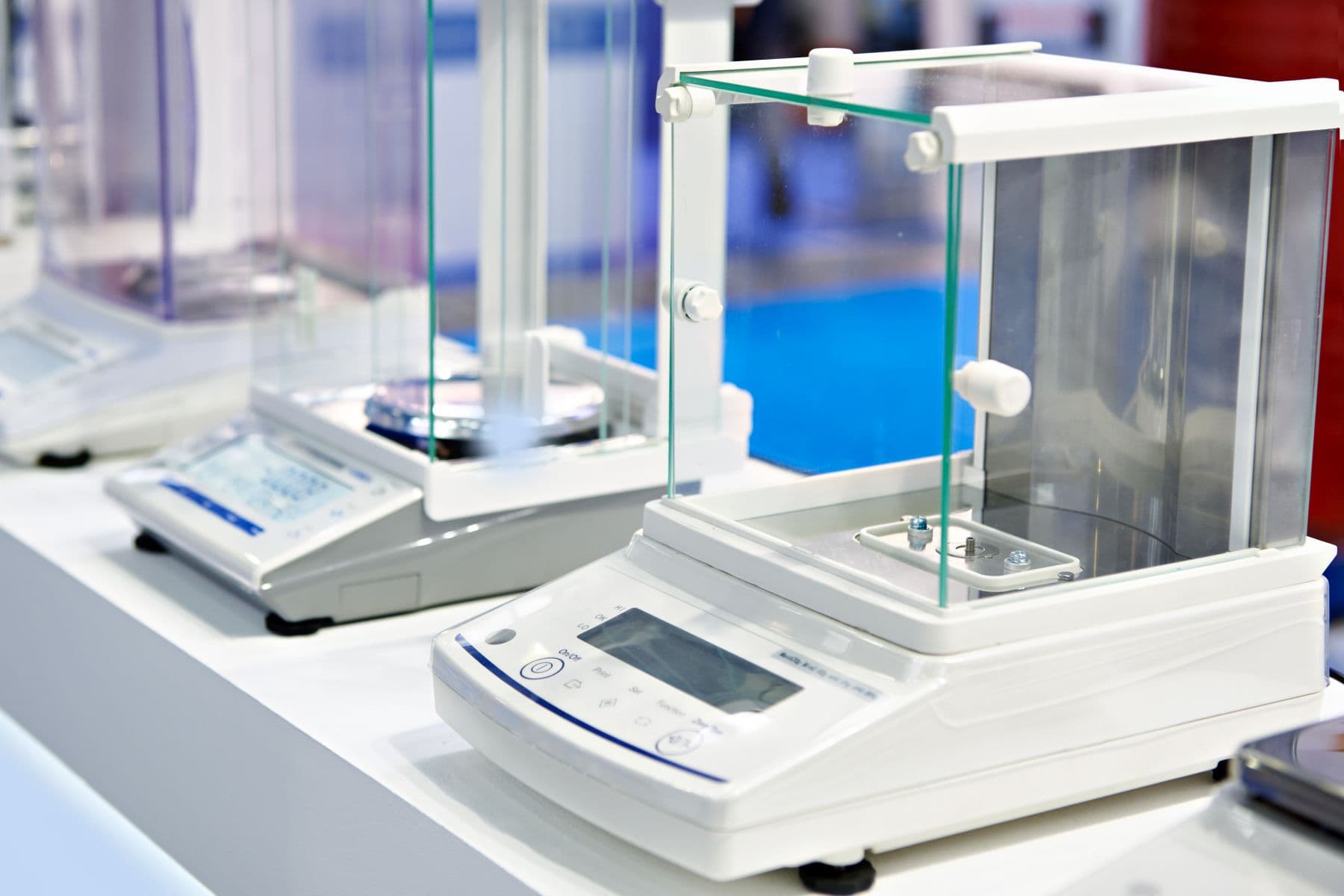
PT kits for labs that calibrate weights, analytical balances, top-loading balances, and bench scales. Each kit is a set of test weights characterized in our Mentor, Ohio laboratory. You measure them on your own equipment with your normal procedure, report readings and expanded uncertainties, and receive En scores for every test point.
Choose a program
$695 for one participant, +$100 for each additional technician or instrument measuring the same kit.
| Program | Demonstrates | You'll need | Test points |
|---|---|---|---|
| Mass PT | Mass calibration of Class F weights by your normal comparison procedure. | Balance with at least 500 g capacity. | 50 g, 100 g, 200 g, second 200 g (marked *), 500 g |
| 200 g Analytical Balance PT | Calibration of analytical balances. | Balance with at least 200 g capacity and 0.1 mg readability. | 20 g, 30 g, 50 g, 100 g, 200 g |
| 3 kg Balance PT | Calibration of top-loading balances and small scales. | Balance with at least 3,000 g capacity and 0.01 g readability. | 1 kg, 2 kg, 3 kg |
| 11 kg Bench Scale PT | Calibration of bench scales. | Scale with at least 11 kg capacity and 0.001 kg readability. | 5 kg, 10 kg, 11 kg |
| 15 kg Bench Scale PT | Calibration of bench scales. | Scale with at least 15 kg capacity and 0.001 kg readability. | 5 kg, 10 kg, 15 kg |
What a balance or scale PT tests
A balance PT is not a check of the balance. It checks your calibration process: your reference weights, your procedure, your environment, and your uncertainty budget. You first calibrate the instrument with your own weights and write it up the way you would for a customer. Then you weigh the PT weights at each test point and report the reading with its expanded uncertainty.
Because we know the conventional mass of each PT weight, the difference between your reading and our reference value shows how well your calibration transfers to a real measurement. The En number then shows whether that difference is covered by the uncertainty you claim.
Getting a satisfactory result
- Let the weights acclimate for 24 hours in the room where you will measure.
- Use the same procedure, reference weights, and technician you would use for customer work, so the PT reflects your real capability.
- Report expanded uncertainty at the same coverage (typically k = 2) you use on your certificates. An uncertainty that is unrealistically small is the most common cause of an |En| above 1.
- Handle weights with gloves or tweezers and return them in the original packaging.
More on scoring: how En numbers work.
Mass and balance PT questions
Which mass, scale, and balance proficiency tests do you offer?
Lake Balance offers a Class F weight set mass PT (50 g to 500 g), a 200 g analytical balance PT, a 3 kg top-loading balance PT, and 11 kg and 15 kg bench scale PTs. Each one uses a characterized set of test weights that you measure on your own equipment.
What equipment do we need for a balance or scale PT?
You need a balance or scale with enough capacity and readability for the program. For example, the 200 g analytical balance PT needs at least 200 g capacity and 0.1 mg readability, the 3 kg balance PT needs 3,000 g capacity and 0.01 g readability, and the bench scale PTs need 0.001 kg readability. Each program page lists its requirements.
What do we report?
For a scale or balance PT, you first calibrate the instrument with your own weights as you would for a customer, then weigh the PT weights at the listed test points. You report each reading with its expanded uncertainty. For the mass PT, you calibrate the individual weights with your normal mass procedure and report each value with uncertainty.
Why do the PT weights need to acclimate?
Temperature differences between the weights, the balance, and the room cause air currents and drift. That's why the mass, balance, and scale kits ask you to let the weights stabilize at room temperature for 24 hours before you start.
Is mass and balance PT within your ISO/IEC 17043 scope?
Yes. The PJLA L24-898 scope supplement lists mass and mass-related schemes for weights, calibration of scales and balances, and calibration of mass. You can download the certificate and scope from our accreditation page.
Other PT disciplines
We also offer pipette, dimensional, temperature, pressure, flow, and electrical programs. See all proficiency testing.